Work / Solar Fleet Dashboard
One screen for a whole solar fleet.
A full-stack monitoring platform giving real-time visibility into distributed MPPT solar charge controllers and their cellular routers.
Focus
Operational visibility and reliability
Backend
Node.js · Express · IC2 API
Frontend
HTML/JS · Leaflet maps
Hosting
cPanel · Passenger
The problem
Remote sites, no clear picture.
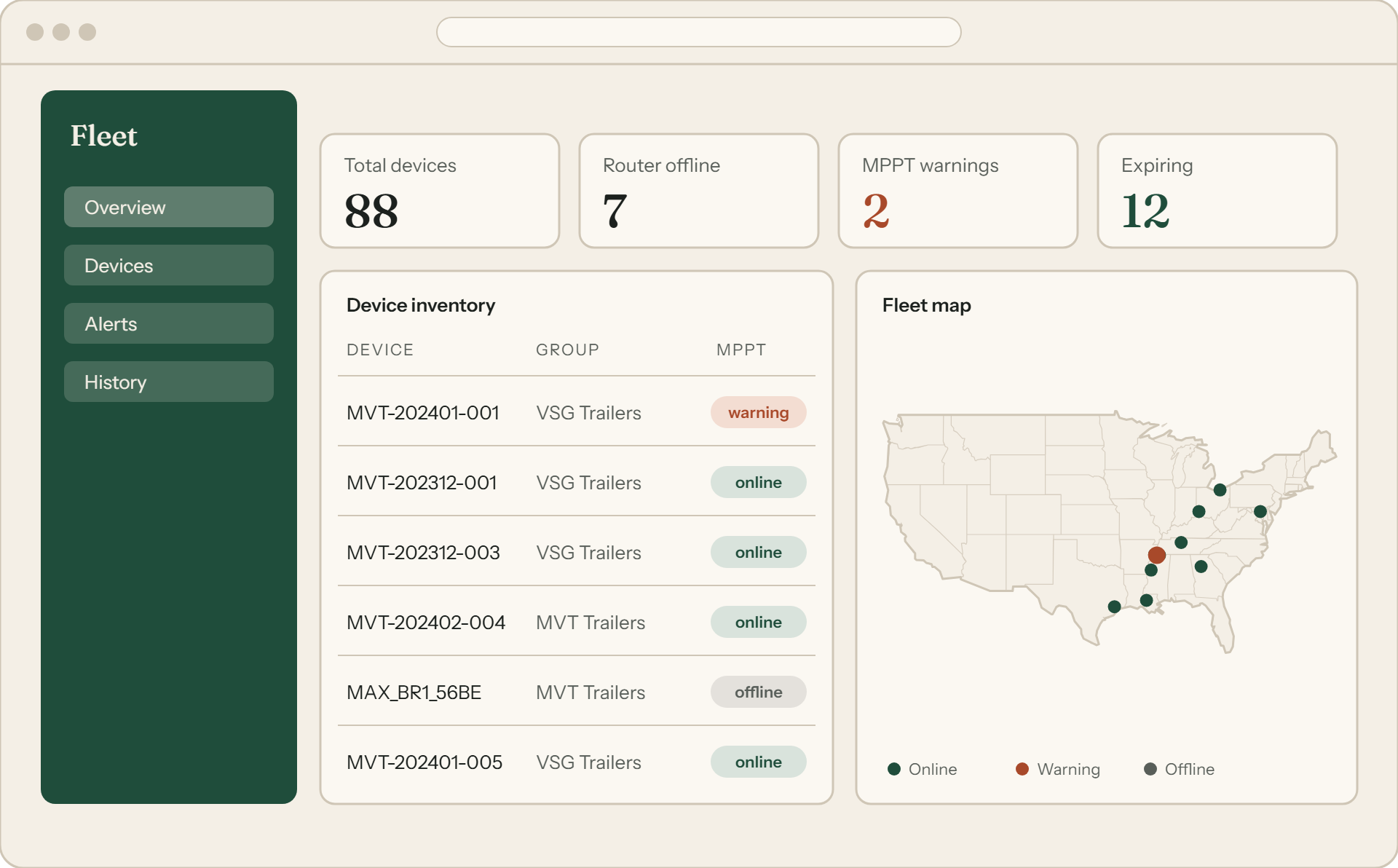
Managing a fleet of solar charge controllers is hard when they’re spread across remote, hard-to-reach locations. Off-the-shelf tools were too generic, too expensive, or didn’t combine controller telemetry with the router data. Operators needed to know:
- Which devices are online and healthy
- Which sites are underperforming or at risk
- When batteries are in danger: over-voltage, under-voltage, temperature
- Whether solar input is enough, or there’s a wiring or shading issue
- How on-site telemetry lines up with cloud device data and locations
The solution
How it works.
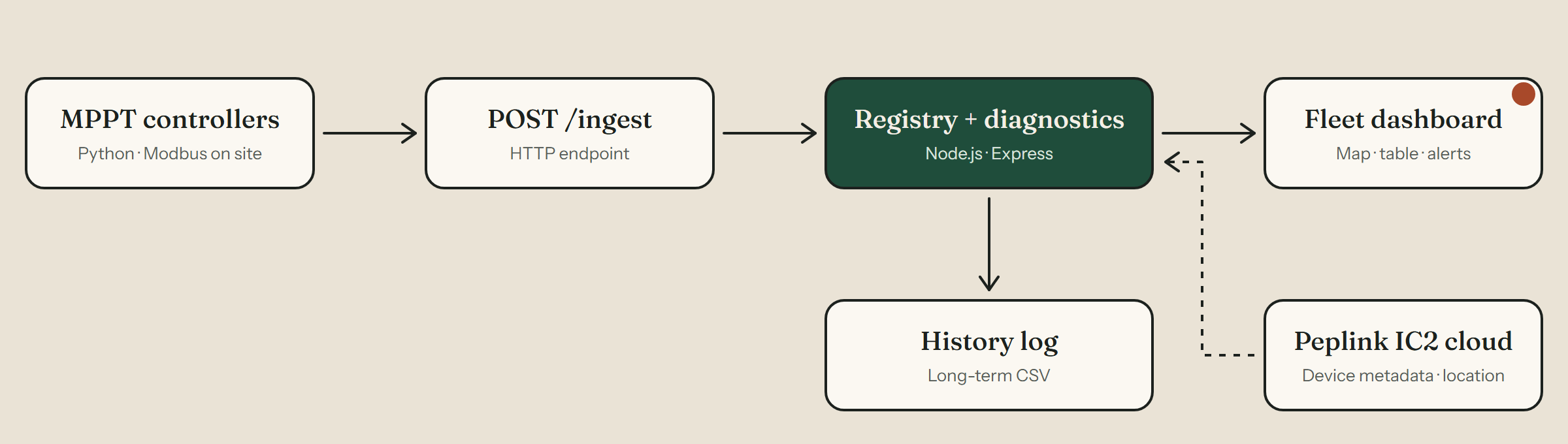
The backend takes in telemetry from each controller, keeps the latest state per device, logs history, merges it with Peplink IC2 cloud data and locations, and serves a clean API to the dashboard.
Key capabilities
What it does.
01
Telemetry ingestion
Controllers post JSON readings to one simple HTTP endpoint.
02
Device registry
A local record per device, with the latest state always on hand.
03
History logging
Every reading is kept for long-term analysis.
04
IC2 integration
Pulls router metadata and last-known locations from Peplink’s cloud.
05
Diagnostics engine
Checks solar, battery, load, temperature and charging state.
06
Voltage detection
Works out 12 V, 24 V or 48 V systems from the readings.
07
Web dashboard
Map, device table and status at a glance, on desktop or tablet.
Low overhead by design.
Runs on ordinary shared hosting (cPanel · Passenger), no heavyweight tooling.
Next project
Executive Support Automation
A 55% survey return rate with PowerApps, Azure Functions and ServiceNow.